Rome Day Tours
I’m Serious Day Tour Man AI, your day trip expert. Ask me anything — where to go, how to get there, and what’s actually worth your day.
Rome keeps its own Pompeii twenty-five minutes away on a commuter train: Ostia Antica, the empire’s port city, preserved to second-story height and visited at a tenth of the famous site’s density. The Pompeii question from Rome gets its arithmetic below.
The rest of the radius: a cardinal’s garden of five hundred fountains and an emperor’s private city sharing one hill town, a cathedral on a volcanic plug reached by funicular, and the Val d’Orcia at the far edge of a committed driving day. The city block covers the booking realities and the free water.
Here’s what’s worth a day, with real times and honest trade-offs.

Popular Day Trips

Ostia Antica
Rome’s port, silted over and saved by abandonment

Tivoli
Two UNESCO villas — don’t cram both

Orvieto
A tufa mesa town, built for a slow day

Pompeii from Rome
The long day south, done honestly

Civita di Bagnoregio
A town on a crumbling pedestal, reached by footbridge

Castelli Romani
Thirteen towns ring two volcanic lakes, thirty minutes out
Ninfa
Open a few dozen days a year — the calendar is the plan
Ostia Antica — Rome’s Own Pompeii
Twenty-five minutes southwest on the Roma–Lido commuter line (from Porta San Paolo by the Piramide metro stop, on an ordinary transit ticket), Ostia Antica preserves the empire’s harbor city to remarkable completeness: apartment blocks to the second floor, the theatre still hosting summer performances, the forum baths’ mosaics in place, and the merchants’ square where the mosaic “shop signs” — elephants for ivory traders, ships for the grain fleets — still advertise businesses dead nineteen centuries.
The argument, stated plainly: Ostia delivers most of what visitors want from Pompeii — walkable ancient streets, houses, taverns (the thermopolium keeps its marble counter and menu frescoes), and scale — without the four-plus transit hours, the crowds, or the named-ticket mechanics. What it lacks is the volcano and the casts; what it adds is shade, space, and, on a weekday, ruins you walk nearly alone.
Closed Mondays, seasonal closing times (last entry an hour before), tickets at the gate or via the official CoopCulture channel, and comfortable shoes for the uneven decumanus stones. The same train continues to Lido di Ostia’s local beach for the summer cool-down. Half to full day by appetite, and the correct first “ancient day” of any Rome trip.
Read the full Ostia Antica day-trip page.
Tivoli — The Emperor and the Cardinal
An hour east, Tivoli stacks two UNESCO sites a few kilometers apart, and the order is the strategy: Hadrian’s Villa first, in the morning cool — the emperor’s 120-hectare private city, larger than Pompeii, where the Canopus reflecting pool with its caryatids remains the single most photographed piece of imperial leisure anywhere — then lunch in Tivoli town, then Villa d’Este in the afternoon, when the light works the fountains.
Villa d’Este is the cardinal’s answer to the emperor: the sixteenth-century terraced garden of five hundred fountains — the Hundred Fountains’ mossy line, the Organ Fountain that plays by water pressure on schedule, the Rometta’s miniature Rome — all gravity-fed, with no pumps anywhere in the system. The Grotto of Diana reopened after forty years closed; access is limited, so check its status when booking. The villa’s frescoed rooms are the appetizer; the garden is the meal.
The regional train lands at the bottom of Tivoli’s hill (a 15–25 minute climb or local bus to the center), while Hadrian’s Villa sits outside town — the Cotral bus from Ponte Mammolo metro drops closer, and the villa-to-villa transfer is the day’s fiddly part, which is the one genuine argument for the guided versions. Allow two hours per villa; combined tickets cover both. Full day, and the richest single day on this list.
Read the full Tivoli day-trip page.
Orvieto — The City on the Plug
An hour and a quarter north by direct regional train, Orvieto sits complete on a sheer-sided volcanic plug, reached from the station by funicular — the ride takes ninety seconds — with the Umbrian plain falling away on every side.
The cathedral is the reason to make the trip: the facade’s golden mosaics and Maitani reliefs form Italy’s Gothic masterpiece wall, and inside, the San Brizio chapel holds Signorelli’s Last Judgment cycle — the muscular damned that Michelangelo studied before painting his own. The counterpoint below: St. Patrick’s Well, the 62-meter double-helix shaft where two spiral staircases (one down, one up, never meeting) let mule trains water the city under siege — descending is the vertiginous ritual, and the climb back is real exercise.
The rest: Orvieto Underground’s cave-network tours (the city is drilled through with Etruscan and medieval workings), the Torre del Moro’s midpoint panorama, and the Classico — the town’s straw-gold white — poured with the umbrichelli at lunch. The frame: Orvieto fills its own day at strolling pace and shouldn’t share it. Take it slowly, eat well, and ride the evening train home.
Read the full Orvieto day-trip page.
Montalcino & the Val d’Orcia — The Tuscany Stretch
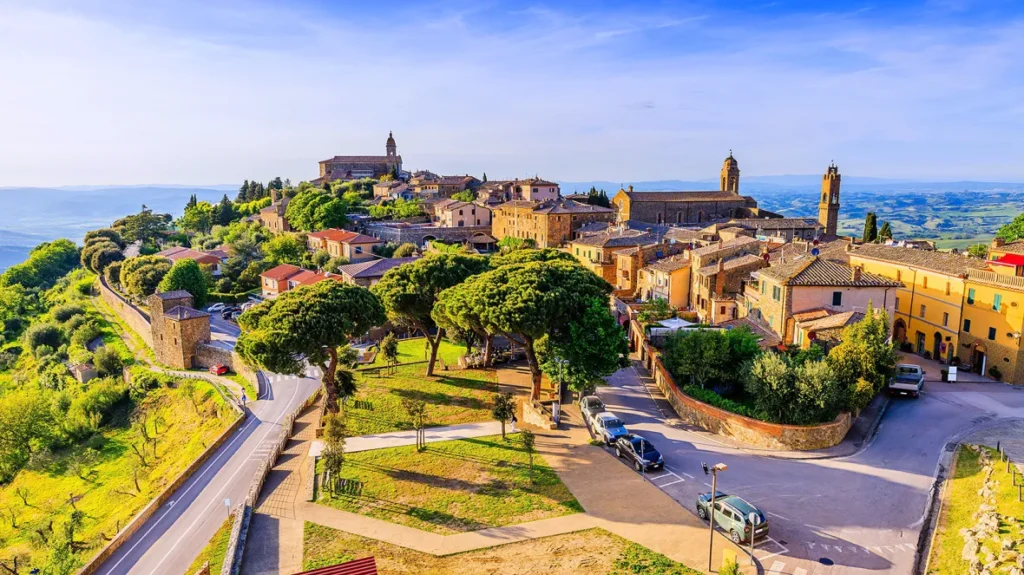
The Val d’Orcia — cypress lanes, wheat hills, the UNESCO farmscape on every Tuscany poster — starts two and a half hours north, and the math comes first: this is the radius’s outer edge, a driving or small-group-tour day of five-plus road hours, worth it for wine-and-landscape travelers and wrong for anyone who resents a windshield.
Montalcino anchors it: the hill town whose Brunello — Sangiovese aged for years before release, and Italy’s most famous collector wine — pours in the fortress’s enoteca (the ramparts double as the tasting terrace), the town’s cellar doors, and the estates below, where tastings book ahead and spitting is respected practice for the designated driver. The Sant’Antimo abbey, ten minutes south in its olive-grove hollow, adds Romanesque perfection and, at the right hours, chanted offices.
The circuit beyond: Pienza — the pope’s designed Renaissance town, pecorino capital, with the Val d’Orcia framed in every alley’s end — San Quirico’s gardens, and the Vitaleta chapel and cypress clumps, photographed from the marked pull-offs. Two towns, one tasting, one long lunch: the compressed form of a trip better run from a Siena or farmhouse base, taken knowingly. Drivers appoint the abstainer before the first pour; everyone else books the small-group tour and sleeps home.
The Pompeii Question — From Rome, Honestly
Pompeii runs from Rome daily, and the arithmetic comes first: the high-speed train reaches Naples in about seventy minutes, but the onward leg — Circumvesuviana or the Campania Express to Pompei Scavi — stretches door-to-door transit past two and a half hours each way, wrapped around a site that honestly wants four-plus hours and sells named, capacity-capped tickets in season (booked ahead on the official pompeiisites.org, ID to match). The compressed day exists, works, and returns tired.
Two verdicts: Pompeii-plus-Naples-lunch is the defensible single day for the committed — earliest train, pre-booked entry, the forum-baths-Villa dei Misteri spine, pizza near the station, home by dinner — while Pompeii-plus-Amalfi in one day from Rome is a brochure fiction that shortchanges both by hours. Travelers with two Naples days do it properly; travelers with one Rome day and ancient appetites take Ostia (above) and bank the difference.
For those going: the named ticket matches your passport, summer caps make advance booking mandatory rather than smart, water and hat are equipment (the site is shadeless), and Vesuvius or Herculaneum are separate days, whatever the combination tours claim. The Archaeological Museum in Naples — where Pompeii’s actual treasures live — is the pairing that upgrades the trip for art-first visitors.
The Booking Realities, the Nasoni & Rome Itself
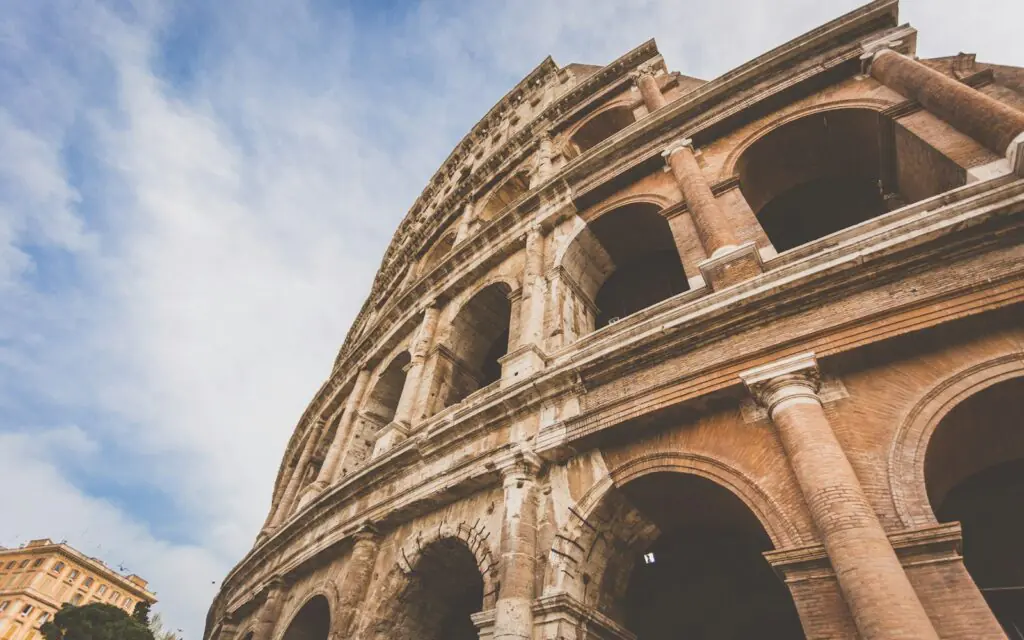
The two queues that define Rome trips, mechanically: the Colosseum sells timed tickets through the official channel with the underground-and-arena add-ons as the tours worth planning around (release windows sell fast; third-party markups resell the same slots), and the Vatican Museums run timed entry where the strategy is binary — book the earliest slot or a late-afternoon one, never midday, and know the free last Sunday of the month buys its savings in density. St. Peter’s itself is free with a security line that the dawn visit deletes; the dome climb is the supplement worth the sweat.
The city’s own rules: the nasoni — Rome’s 2,500 continuously running drinking fountains — make bottled water a tourist tax (block the spout’s end and the arc jets up); the piazzas are nearly empty between 7 and 9 a.m., so walk the centro then; and the coin over the shoulder at Trevi happens fastest at dawn or after 11 p.m., when the fountain is actually visible. Trastevere and Testaccio split the eating argument — the former for the evening theatre, the latter for the market-and-trattoria substance — and the carbonara-amatriciana-cacio e pepe trilogy is completed across days, not one sitting.
The season math runs plainly: April–June and September–October are the windows; August is hot and half-closed as Romans leave town (drink from the fountains constantly); Jubilee and holy-year events reprice and re-queue the Vatican side of the river — check the calendar against your dates; and the seven hills add a climb to every “ten-minute walk” that the maps don’t show. The evening passeggiata with gelato — artigianale flag, covered tubs, pistachio the color of the nut — costs a few euros and ends every Roman day well.
Full day-trip pages: Civita di Bagnoregio.
Full day-trip pages: the Castelli Romani.
Full day-trip pages: Ninfa.
Frequently Asked Questions
Is Ostia Antica really a substitute for Pompeii?
For most visitors, functionally yes — second-story ruins, mosaics, theatre, and taverns twenty-five minutes away on a transit ticket, without crowds or caps. Pompeii adds the volcano story and the casts; Ostia adds shade, space, and your whole afternoon back.
What’s the right order in Tivoli?
Hadrian’s Villa in the morning cool, lunch in town, Villa d’Este when afternoon light hits the fountains — two hours each, combined tickets available. The villa-to-villa transfer is the fiddly part; the Cotral bus from Ponte Mammolo serves Hadrian’s Villa best.
Can you do Pompeii as a day trip from Rome?
Yes, as a committed one: 2.5-plus hours door to door each way, named capacity-capped tickets booked ahead on the official site, four hours minimum inside. Pompeii-plus-Amalfi in a day is brochure fiction; with one day and ancient appetites, Ostia wins.
Is the Val d’Orcia doable from Rome?
As a long driving or small-group day, yes — Montalcino’s Brunello, Pienza, Sant’Antimo, and the cypress viewpoints in five-plus road hours. It compresses a Siena-based trip into one day, taken knowingly, with the driver question settled first.
What are the nasoni?
Rome’s 2,500 free-running drinking fountains — cold, potable, and everywhere. Block the spout’s end to arc the water upward, refill the bottle, and skip the €3 tourist water for the length of your stay.